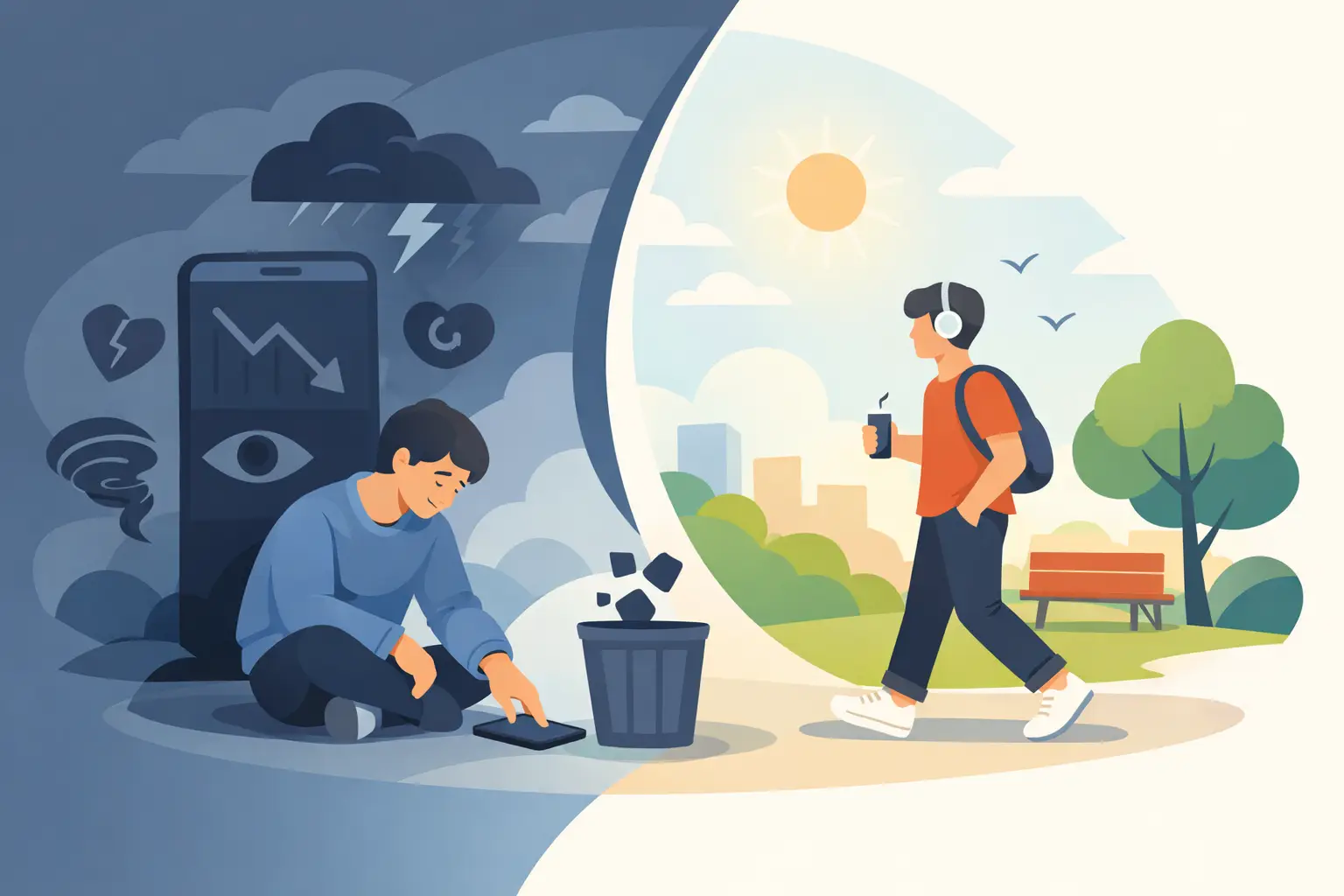
Your thumb may be moving long after your mind has had enough. You open your phone for one update, then find yourself reading increasingly distressing posts, feeling tense and oddly unable to stop. Learning how to stop doomscrolling habits is not about becoming indifferent to the world. It is about protecting your attention and emotional energy so you can respond to life with more steadiness.
Doomscrolling is often treated as a simple failure of self-control. That explanation is incomplete and, for many people, unhelpful. These habits are shaped by a nervous system trying to find certainty, by platforms designed to hold attention, and by real concerns that deserve care. A lasting change begins with compassion, then adds structure.
Why doomscrolling is so hard to stop
When the news feels threatening or uncertain, your brain naturally looks for more information. This is an understandable attempt to regain a sense of control. The problem is that an endless feed rarely provides closure. Instead, each alarming headline creates another reason to keep checking.
Negative information also carries particular weight. From an evolutionary perspective, noticing possible danger helped humans survive. Online, that attentional bias can be repeatedly activated within minutes. Your body may respond as though each post requires immediate action, even when there is nothing useful you can do at that moment.
There is also intermittent reinforcement at work. Most posts may be repetitive, upsetting, or irrelevant. But occasionally you find a useful update, a moment of connection, or a piece of hopeful news. That unpredictable reward teaches the brain to continue checking, much like pulling a lever again because the next pull might pay off.
This does not mean you are weak or careless. It means the habit has a function. Before you try to remove it, it helps to understand what it is trying to provide: reassurance, distraction, connection, preparation, or relief from an uncomfortable feeling.
How to stop doomscrolling habits by changing the loop
A habit is often a loop: a cue prompts a behavior, and the behavior delivers a short-term reward. With doomscrolling, the cue might be waking up, waiting in line, feeling lonely, or hearing a notification. The behavior is opening a feed. The reward may be temporary distraction or the feeling that you are staying informed.
Rather than relying on willpower at the moment of temptation, adjust one part of that loop in advance. Start by noticing your personal pattern for several days. Ask yourself: When do I scroll the longest? What feeling is present just before I begin? How do I feel afterward?
This is not an exercise in self-criticism. It is useful data. You may discover that late-night scrolling is less about news and more about exhaustion, or that checking social media between meetings is a response to stress. Different cues need different solutions.
Make your phone slightly less automatic
Small amounts of friction can interrupt an automatic behavior without requiring a dramatic digital detox. Move news and social apps off your home screen. Turn off nonessential alerts. Log out of the apps that pull you in most often, or use a browser rather than the app when you genuinely want an update.
You can also create phone-free boundaries around moments that shape your day. Keep the first 20 minutes after waking and the final 30 minutes before sleep free from news feeds. These are not arbitrary rules. Morning scrolling can set an anxious emotional tone, while nighttime scrolling can keep your mind activated when it needs to settle.
The goal is not to make your phone inaccessible. It is to create a brief pause in which you can choose rather than react.
Set a container for staying informed
Being informed and doomscrolling are not the same thing. One is intentional; the other is open-ended and draining. Choose one or two reliable sources and decide when you will check them. For example, you might read a news briefing over lunch for 15 minutes and avoid live updates outside that window.
A clear container reduces the fear that you will miss something crucial. If a genuine emergency affects your safety or responsibilities, appropriate alerts and direct communication can still reach you. Most information does not need to arrive in real time.
It may help to ask one grounding question before you open a feed: “What am I looking for right now?” If you cannot name a purpose, take that as a cue to do something else for five minutes. Often, the urge will soften when it is not immediately fed.
Replace the need, not just the behavior
If scrolling helps you escape stress, removing it without another source of relief can leave a difficult gap. Plan a replacement that is easy enough to use in the same moment. The best option depends on what you need.
When your mind is overstimulated, try a brief sensory reset: step outside, make tea, stretch, or take five slow breaths while noticing your surroundings. When you are lonely, send a voice note to someone you trust instead of scrolling through strangers’ reactions. When you are seeking control, write down one practical action you can take today, however small.
Positive Psychology emphasizes that wellbeing is not merely the absence of distress. It is also the presence of meaning, connection, engagement, and agency. A replacement habit works better when it gives you a real version of what the scroll was only promising.
Use self-compassion without letting yourself off the hook
Shame tends to strengthen doomscrolling. After an hour online, you may think, “I have wasted my evening again,” then feel worse and reach for the same distraction. A more effective response is both kind and accountable: “I got caught in a pattern that leaves me depleted. What would help me reset now?”
Resetting can be very small. Put the phone in another room, drink water, wash your face, or begin the next activity you had planned. You do not need to wait for tomorrow, Monday, or a perfect fresh start. Each interruption is practice for the skill you are building.
At the same time, compassion should not become vagueness. If a particular app consistently disrupts your sleep, relationships, or work, name that honestly. You may need stronger boundaries, such as deleting it for a month, using a site blocker during work hours, or asking a friend to support your experiment.
Create a plan for high-risk moments
Doomscrolling often intensifies when you are tired, emotionally raw, or facing uncertainty. Identify the moments when your usual intentions are most likely to fade, then make decisions before you are in them.
A simple if-then plan can help: “If I feel the urge to check headlines in bed, then I will put my phone on the charger in the kitchen and read two pages of a book.” The plan does not have to be perfect. It simply gives your brain a prepared route when decision-making is low.
Consider your environment, too. Charge your phone outside the bedroom if sleep is suffering. Keep a physical book, journal, or calming activity where you usually scroll. Tell the people you live with what you are trying to change, especially if shared scrolling has become part of your routine.
Know when to seek additional support
For some people, doomscrolling is connected to significant anxiety, depression, grief, trauma, or a feeling of helplessness about world events. If you feel persistently distressed, cannot sleep, struggle to meet daily responsibilities, or use scrolling to avoid emotions that feel unmanageable, support from a qualified mental health professional can be an important next step.
You do not need to prove that your struggle is severe enough before asking for help. A therapist can help you explore the deeper needs beneath the behavior and build strategies that fit your circumstances.
Your attention is a limited and valuable resource. Treating it with care is not avoidance, and it is not selfish. It is a way of making room for the relationships, work, rest, and meaningful action that deserve more of you than an endless feed ever can.