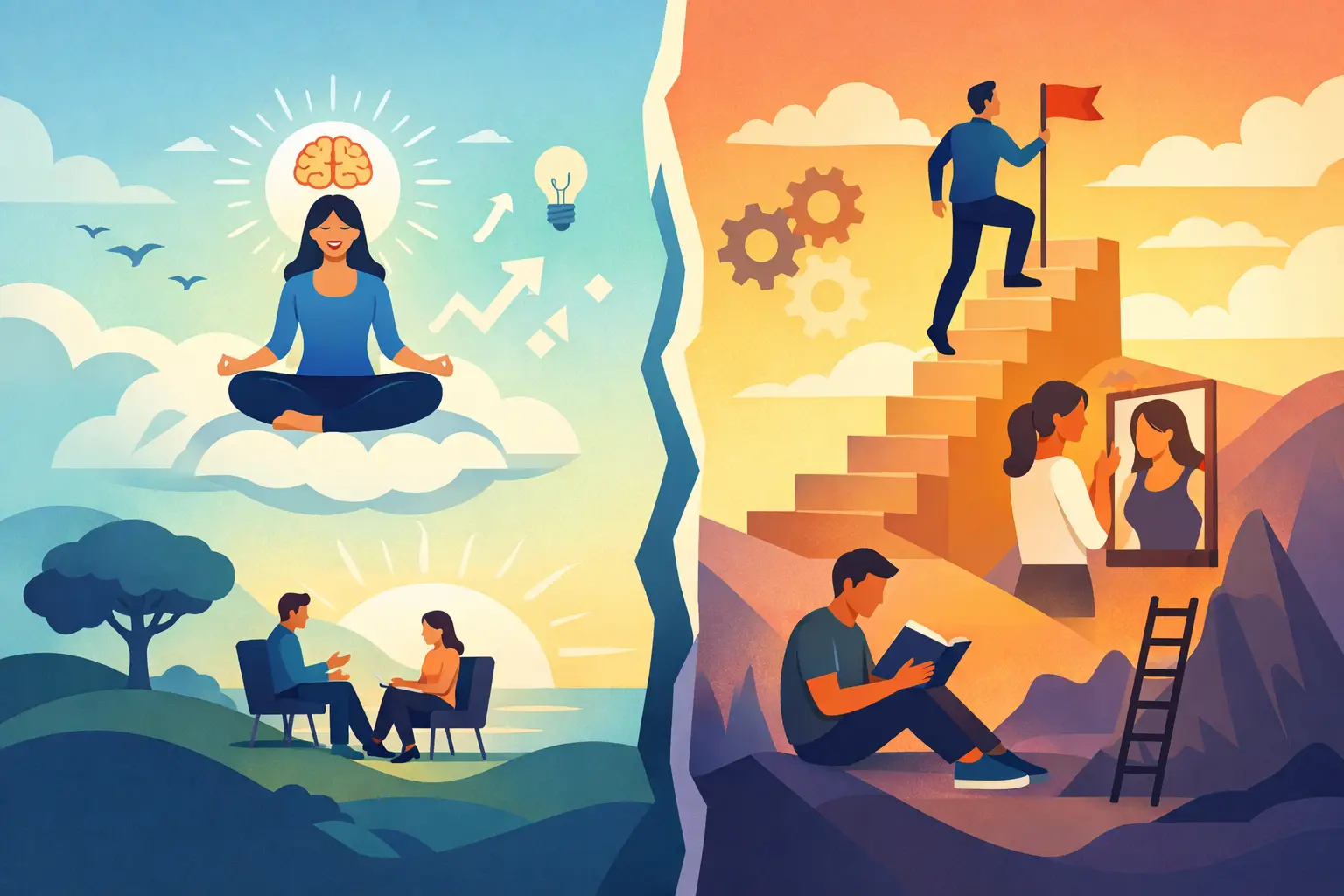
If you have ever closed a self-help book feeling inspired for a day and discouraged by the end of the week, you are not imagining things. The gap between feeling motivated and actually changing your life is where the conversation around positive psychology vs self help becomes useful. These two approaches often get grouped together, but they are not the same thing, and knowing the difference can save you time, energy, and disappointment.
At a glance, both promise growth. Both talk about mindset, habits, purpose, and becoming a better version of yourself. But one is largely built around advice, personal philosophy, and motivation, while the other is grounded in research on what helps people thrive. That difference matters, especially if you are already carrying stress, burnout, or the quiet frustration of trying hard without seeing lasting results.
What positive psychology vs self help really means
Self-help is a broad category. It includes books, podcasts, courses, influencers, and frameworks that aim to improve your life. Some of it is thoughtful and genuinely useful. Some of it is simplistic, commercialized, or emotionally tone-deaf. The quality varies because self-help is not one unified field. It is a marketplace of ideas.
Positive psychology is different. It is a branch of psychology focused on human flourishing, wellbeing, strengths, meaning, resilience, positive emotion, and healthy functioning. Rather than asking only what reduces distress, it also asks what helps people build satisfying and meaningful lives. It studies those questions through research, not just opinion.
That does not mean positive psychology is against ambition or inspiration. It means the guidance tends to be more disciplined. Instead of saying, "just think positively," it is more likely to ask which mental habits are associated with better coping, under what conditions, and for whom.
Why people confuse them
The confusion makes sense because both often use similar language. Gratitude, mindset, optimism, purpose, and resilience all appear in self-help and positive psychology. On the surface, they can sound nearly identical.
The difference is in how the ideas are formed and applied. Self-help often starts with a claim, a story, or a personal success formula and then builds a message around it. Positive psychology begins with observation, testing, and evidence. It looks for patterns across people rather than relying on one person’s charisma or personal breakthrough.
This distinction is especially important when life feels heavy. If you are overwhelmed, grieving, anxious, or emotionally depleted, generic encouragement can feel hollow. Science-informed guidance is not automatically perfect, but it is more likely to respect complexity.
The strengths of self-help
It would be unfair to dismiss self-help outright. Good self-help can be clear, motivating, and accessible. It often introduces useful ideas to people who might never pick up an academic text or sit in a psychology course. It can make growth feel possible. Sometimes that spark matters.
Self-help also speaks directly to experience. A well-written self-help book can put language to emotions you have struggled to name. It can help you feel less alone. And in some cases, it can prompt real behavior change, especially when the advice is practical and realistic.
The trade-off is that self-help is not always accountable to evidence. Advice may be based on personal belief, selective anecdotes, or overconfident claims. When that happens, readers can end up blaming themselves for not succeeding with a method that was never very sound to begin with.
The strengths of positive psychology
Positive psychology offers a steadier foundation. It looks at what contributes to wellbeing in measurable ways, including relationships, engagement, strengths, meaning, accomplishment, and emotional balance. It does not assume there is one universal fix. It tends to recognize that humans are shaped by context, personality, environment, and life circumstances.
This makes it especially helpful for people who want more than a motivational high. If you are looking for practices that can be repeated, reflected on, and integrated into daily life, positive psychology often provides a more useful path. Its tools are less about dramatic reinvention and more about sustainable growth.
That grounded approach can also be gentler. There is less pressure to become endlessly productive or relentlessly upbeat. Instead, the aim is often to build psychological resources that support a fuller life, even when life is imperfect.
Positive psychology vs self help in everyday life
The clearest way to understand positive psychology vs self help is to look at how each approach handles common struggles.
If you are feeling stuck in your career, self-help might tell you to think bigger, stop limiting yourself, and take bold action. Sometimes that message is useful. But if it ignores fear, financial reality, identity, or burnout, it can become shallow fast.
Positive psychology would be more likely to ask different questions. What are your core strengths? When do you feel engaged rather than drained? What kind of work supports meaning, not just status? How can you build hope and agency in a realistic way? That approach may sound less dramatic, but it is often more effective because it works with your actual life.
If you are struggling with low mood, self-help may push affirmations or positivity as the answer. Positive psychology is usually more nuanced. It may include practices such as gratitude or identifying strengths, but not as a way to deny pain. The goal is to expand your internal resources, not shame you out of difficult emotions.
Where self-help can go wrong
The biggest problem with low-quality self-help is not that it encourages growth. It is that it often oversimplifies human change. It can suggest that outcomes are mostly a matter of mindset, discipline, or desire. For someone already feeling fragile, that message can turn into self-judgment.
This is where phrases like "good vibes only" or "manifest your reality" can become harmful. They imply that distress is a failure of attitude. They leave little room for trauma, structural barriers, mental health conditions, or the normal messiness of being human.
A science-informed approach does not remove responsibility, but it places responsibility in context. It recognizes that growth is real work. It also recognizes that people need methods that are compassionate, credible, and adaptable.
Where positive psychology has limits too
Positive psychology is not above critique. Research can be misapplied, oversimplified, or stripped of context once it reaches mainstream culture. Some positive psychology practices also risk sounding formulaic if they are offered without sensitivity to a person’s emotional state.
It is also not a replacement for therapy, medical care, or deeper psychological treatment when those are needed. Wellbeing science can be powerful, but it is not a cure-all. If someone is dealing with major depression, trauma, or severe anxiety, a worksheet on strengths is not enough on its own.
That is why the most responsible use of positive psychology is practical, humane, and flexible. It should support people, not pressure them.
How to choose what actually helps you
A helpful question is not whether self-help is bad or positive psychology is good. A better question is whether the guidance you are using is helping you change in a way that feels honest and sustainable.
Look for advice that respects reality. Look for frameworks that encourage reflection rather than emotional performance. Look for methods that help you understand yourself, not just fix yourself.
If a resource leaves you feeling temporarily energized but fundamentally inadequate, be cautious. If it gives you language, structure, and repeatable practices that support your wellbeing over time, it is probably moving in a healthier direction.
This is why many people eventually outgrow generic personal development and begin seeking something more grounded. They do not need louder motivation. They need a calmer, more reliable way forward. That is where psychology-informed growth stands apart, and it is also what platforms like Live Like Jay are built to offer.
A better way to think about growth
You do not have to reject all self-help to value evidence. And you do not have to become academic to want a more trustworthy path. The real opportunity is to become more discerning.
Take the inspiration that helps you begin. But build your life on practices that can hold up after the mood fades. Growth is rarely about becoming a new person overnight. More often, it is about learning how to support the person you already are with more clarity, more compassion, and better tools.
If your personal development journey has felt noisy, inconsistent, or strangely exhausting, that may not be a sign that you are failing. It may simply be a sign that you are ready for an approach that treats your wellbeing with more care.