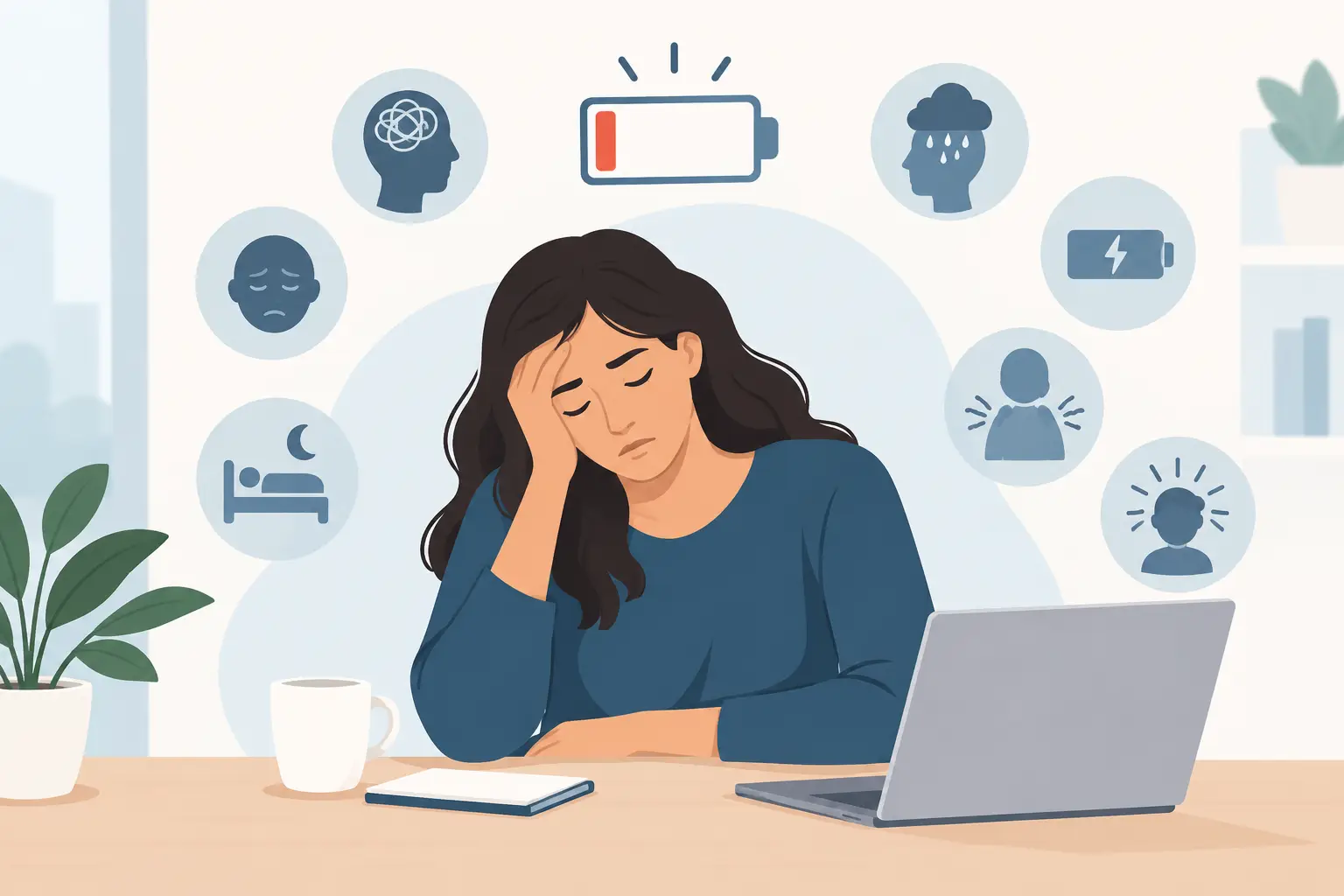
Your calendar may still look full. You may still answer messages, meet deadlines, care for people, and say “I’m fine” when someone asks. Yet the ordinary tasks that once took effort can start to feel strangely heavy. Recognizing the signs of emotional exhaustion can help you respond before depletion becomes your default way of living.
Emotional exhaustion is not a character flaw or proof that you are failing at life. It is often the mind and body’s understandable response to carrying more emotional demand than your current resources can restore. Work pressure can contribute, but so can caregiving, financial uncertainty, conflict, grief, chronic self-criticism, or the ongoing effort of appearing capable when you feel anything but.
What emotional exhaustion can look like
Emotional exhaustion develops differently for different people. Some become visibly overwhelmed; others grow quieter, more efficient, and less connected to themselves. The common thread is that your capacity to process feelings, make decisions, and respond to everyday demands begins to narrow.
1. Small tasks feel disproportionately difficult
Replying to an email, making dinner, choosing what to wear, or returning a call may feel like too much. This is not necessarily laziness or a lack of discipline. When your mental energy is depleted, even simple decisions require effort your system does not feel it has available.
2. You feel detached from things you usually value
You may go through the motions at work, in relationships, or in hobbies without feeling present. A sense of numbness can be protective in the short term: it creates distance from feelings that seem too difficult to carry. Over time, though, it can make life feel flat and disconnected.
3. Your patience has become thinner
Irritability is one of the more overlooked signs of emotional exhaustion. You might snap at a loved one, feel intensely frustrated by minor delays, or resent requests that you would normally handle with ease. The issue is not that you have suddenly become an unkind person. It may be that you have little reserve left.
4. Rest does not feel restorative
A quiet evening, a long sleep, or a free weekend may bring temporary relief without helping you feel genuinely renewed. This can happen when the source of depletion is not just a busy schedule, but sustained emotional strain. Sleep matters, but it cannot fully resolve an unresolved workload, a painful relationship dynamic, or a life organized around constant overextension.
5. You struggle to concentrate or make decisions
Your thoughts may feel scattered, slow, or unusually foggy. You reread the same paragraph, forget what you walked into a room for, or postpone decisions because every option feels overwhelming. Stress can affect attention and working memory, especially when your mind is continuously scanning for the next demand.
6. You withdraw from people who care about you
Declining plans or taking time alone is not inherently a concern. Solitude can be restorative. Withdrawal becomes more meaningful when connection feels like another obligation, when you do not have the energy to explain yourself, or when you start to believe you have nothing worthwhile to bring to others.
7. You are operating on autopilot
Autopilot can look productive from the outside. You complete what is required, but you are rarely checking in with what you feel, need, or want. Days begin to blend together. This pattern often helps people survive demanding seasons, but it is difficult to thrive when there is no room to be an active participant in your own life.
8. Physical tension or stress symptoms are increasing
Emotional exhaustion can show up physically through headaches, jaw clenching, digestive discomfort, changes in appetite, tight shoulders, or persistent fatigue. These symptoms can have many causes, so they should not be self-diagnosed. Still, they are useful signals to take seriously rather than push aside.
9. You feel cynical, hopeless, or unusually negative
When we are depleted, the brain often becomes more focused on threat, effort, and disappointment. You may assume the worst, doubt that anything will improve, or feel emotionally hardened toward work or people. Cynicism can be a warning that something you have been tolerating is asking for attention.
10. You cannot stop thinking about what needs to be done
Exhaustion does not always look like slowing down. For some people, it looks like relentless mental activity. You may lie awake planning, replay conversations, or feel guilty whenever you are not being useful. This is especially common for conscientious people whose self-worth has become closely tied to being dependable.
11. You have less compassion for yourself
Instead of noticing that you are overloaded, you may criticize yourself for not coping better. You tell yourself that others have it harder or that you should be grateful. Perspective can be valuable, but comparison is not a recovery strategy. Emotional pain does not need to win a competition to deserve care.
12. Joy feels inaccessible, not merely postponed
There are seasons when pleasure naturally takes a back seat to urgent responsibilities. Emotional exhaustion can make that feeling more persistent. Things that usually offer comfort or meaning may no longer reach you, and even good moments may feel distant. If this lasts for weeks or affects your ability to function, it deserves support.
Why emotional depletion builds so quietly
Many people expect exhaustion to arrive as a dramatic breaking point. More often, it accumulates through small, repeated moments of override: answering one more message, staying agreeable to avoid conflict, skipping lunch, minimizing disappointment, or taking responsibility for problems that are not yours to solve.
Modern life rewards this kind of endurance. Being busy can be treated as evidence of value, while rest is framed as something to earn. Positive Psychology offers a more sustainable perspective: wellbeing is not created by forcing positivity over difficult circumstances. It grows through conditions that support agency, supportive relationships, meaning, realistic accomplishment, and positive emotion. When several of these conditions are missing for too long, depletion makes sense.
That does not mean every stressor can be removed. A parent with a newborn, a student in exam season, or someone navigating illness may have limited control over their demands. The practical question is not always, “How do I make life easy?” It may be, “Where can I reduce unnecessary pressure, increase support, and stop spending energy against myself?”
How to respond without adding another project
Start by naming what is true. Rather than saying, “I need to get it together,” try, “I have been carrying a lot, and my capacity is low.” This shift may sound small, but it replaces judgment with accurate information. Accurate information makes better choices possible.
Next, choose one demand to reduce, delay, delegate, or do less perfectly this week. Emotional exhaustion rarely responds well to an ambitious recovery plan. A smaller meeting load, a simplified meal routine, a postponed nonessential commitment, or a clearer boundary around after-hours messages can create meaningful breathing room.
It also helps to distinguish rest from avoidance. Watching television for an evening can be restorative if it helps you decompress. It may be less restorative if you use it to avoid a conversation, decision, or feeling that continues to consume mental space. A balanced recovery plan usually includes both genuine downtime and one gentle action toward the source of strain.
Connection matters, too. Tell one trusted person something more specific than “I’m stressed.” You might say, “I’m functioning, but I feel emotionally worn down and could use company,” or “I need help thinking through what I can take off my plate.” Support becomes more useful when people understand what kind of support you need.
When to seek additional support
Emotional exhaustion can overlap with anxiety, depression, burnout, trauma responses, and physical health conditions. You do not need to determine the exact label alone. Consider speaking with a licensed mental health professional or health care provider if low mood, numbness, hopelessness, sleep changes, panic, or difficulty functioning persist or worsen.
Seek urgent help right away if you are thinking about harming yourself, feel unable to stay safe, or are in immediate danger. In the United States, call or text 988 to reach the Suicide & Crisis Lifeline, or call emergency services if there is immediate risk.
Your exhaustion is not asking you to become a different person. It may be asking you to treat your limits as real, your needs as valid, and your wellbeing as something worthy of protection before you reach the point of collapse.