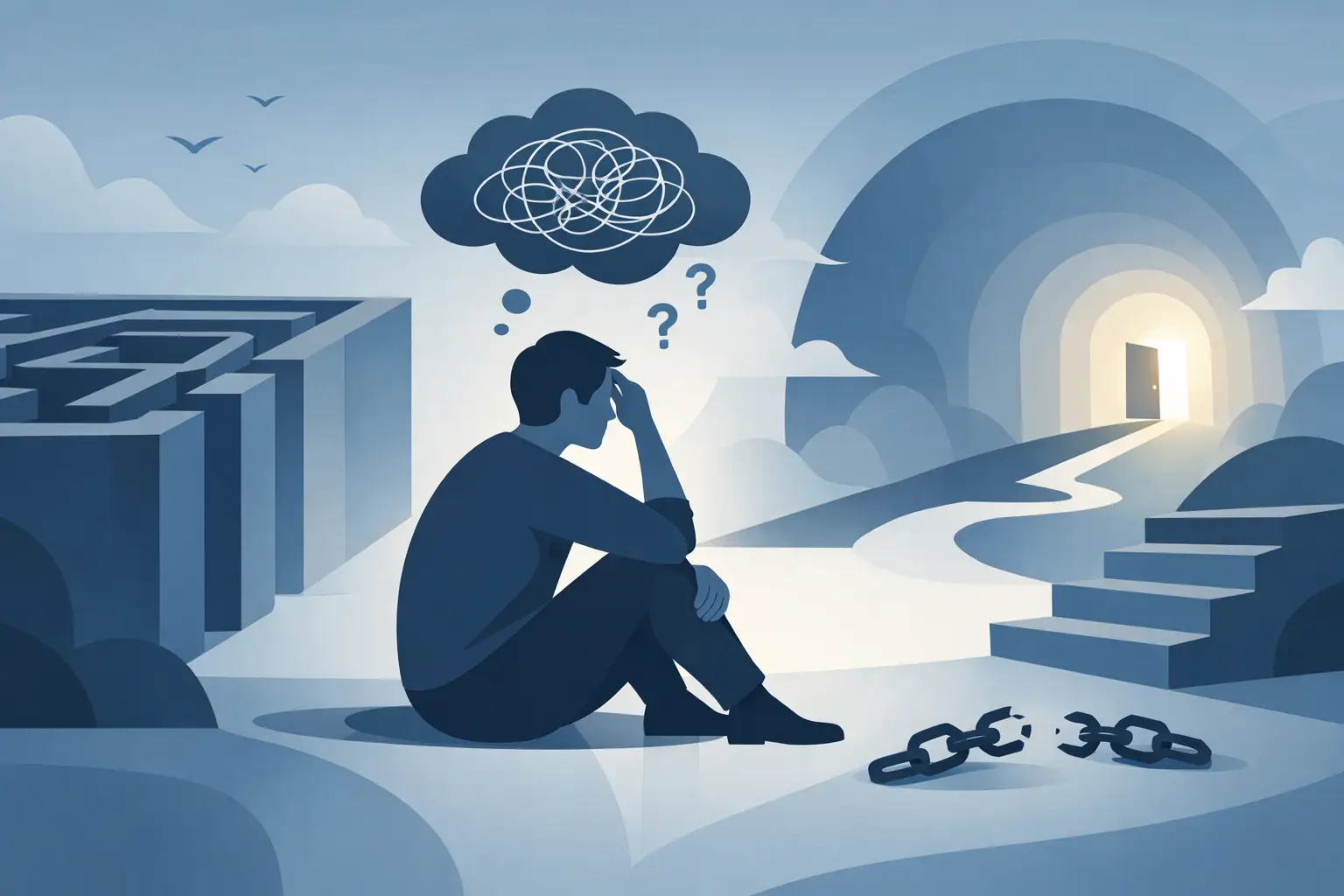
Some versions of feeling stuck are loud. You miss deadlines, avoid decisions, and scroll longer than you meant to. Other versions are quieter. You keep functioning, but underneath the routine, the same question keeps showing up: why do I feel stuck when I want things to change so badly?
That question usually does not mean you are lazy, broken, or lacking ambition. More often, it points to friction between your inner world and your outer life. You may be carrying stress that has outlasted your coping capacity. You may be trying to force clarity before you have enough emotional safety to hear yourself. Or you may simply be living in a way that no longer fits who you are.
Why do I feel stuck even when I’m trying?
This is one of the most frustrating parts. Many people assume that if they care enough, read enough, or plan well enough, they should be able to move forward. But human behavior is not driven by insight alone. Motivation depends on energy, emotion, context, belief, and nervous system state.
If you are trying and still not moving, there is usually a reason. In Positive Psychology and behavioral science, progress tends to happen when people have a workable mix of meaning, self-efficacy, emotional regulation, and manageable goals. When one or more of those pieces is missing, effort can start to feel like pushing against a locked door.
Sometimes the issue is burnout. Sometimes it is fear dressed up as perfectionism. Sometimes it is grief, overstimulation, or a quiet loss of identity after a life transition. Feeling stuck is not one single problem. It is often the surface experience of several things happening at once.
The most common reasons people feel stuck
A stuck season can look simple from the outside, but internally it is often layered. You may recognize yourself in more than one of these patterns.
You are depleted, not unmotivated
When your mind is tired and your body is carrying chronic stress, even basic decisions can feel heavy. This is especially common for high-functioning adults who are still meeting responsibilities but doing so from a place of exhaustion. You may think you need more discipline when what you really need is recovery.
Depletion narrows your perspective. It becomes harder to imagine change, initiate effort, or trust yourself with something new. In that state, staying where you are can feel safer than taking action, even when you are unhappy.
You are waiting for certainty
Many people stay stuck because they are trying to eliminate all doubt before making a move. They want the perfect plan, the right timing, or confidence that the next step will work. The problem is that certainty rarely comes first. More often, clarity grows after action, not before it.
This does not mean you should rush reckless decisions. It means the standard of total certainty may be keeping you in place. There is a big difference between thoughtful pacing and indefinite postponement.
Your goals no longer fit your life
Sometimes you are not stuck because you are failing. You are stuck because you are still pursuing a version of success that no longer feels meaningful. A career path, relationship dynamic, or personal standard that once made sense may now feel draining or strangely empty.
This can be confusing, especially if your life looks fine on paper. But external stability and internal alignment are not the same thing. When your values shift and your habits do not shift with them, stagnation often follows.
Fear is showing up in subtle ways
Fear does not always look dramatic. It often appears as procrastination, overthinking, endless research, or convincing yourself that now is not the right time. At its core, fear is often trying to protect you from disappointment, embarrassment, rejection, or loss.
That protection can become expensive. The longer you avoid the discomfort of change, the more your world can shrink around what feels familiar.
You are overwhelmed by too many possible directions
Feeling stuck is not always about having no options. Sometimes it comes from having too many. When every choice carries consequences and every path asks something different of you, your brain may default to inaction.
This is especially common among thoughtful, growth-oriented people. You care about making a meaningful choice, so you keep analyzing. Eventually, reflection turns into paralysis.
What feeling stuck is trying to tell you
A stuck feeling is often information. Not a verdict, but a signal.
It may be telling you that your current pace is unsustainable. It may be showing you that you have been living on autopilot. It may be exposing a gap between what you say matters and how your life is actually organized. Sometimes it is a sign that you need support, structure, or rest before your next step becomes visible.
This is where self-judgment can get in the way. If you interpret stuckness as a personal failure, you are more likely to respond with pressure. Pressure can create short bursts of action, but it rarely creates lasting change. Curiosity tends to work better. Instead of asking, what is wrong with me, ask, what conditions are keeping me here?
That shift matters. It moves you from shame into observation, and observation is where change becomes possible.
How to move when you feel stuck
The goal is not to transform your entire life by next week. It is to create enough movement that your mind stops experiencing life as frozen.
Start smaller than your ego wants to
When people feel stuck, they often swing toward extreme solutions. New routine. New job. New identity. That urge makes sense, but it can backfire if your nervous system is already strained. Small actions are not a sign that your problem is small. They are a way of rebuilding trust with yourself.
Choose one area where movement would matter most right now. Then reduce the next step until it feels almost too manageable. Send the email. Take the ten-minute walk. Open the document. Write the first honest sentence. Small actions create evidence that you are still capable of change.
Reduce the noise around the decision
Not every problem needs more input. If you have been consuming advice nonstop, you may be saturating your attention instead of clarifying it. Too much information can disconnect you from your own judgment.
Create a little space. Pause the constant comparison. Limit how many opinions you seek. Give yourself room to notice what feels true when the noise settles.
Check your energy before you judge your ambition
If everything feels hard, ask whether your system is under-resourced. Sleep, stress, emotional load, grief, loneliness, and overwork all shape your capacity to act. This is not an excuse. It is context.
Psychology supports what many people learn the hard way: sustainable growth is easier when your basic wellbeing is not being ignored. Sometimes the next right step is not productivity. It is recovery.
Name the fear clearly
Vague fear tends to run the show. Specific fear can be worked with. Try finishing the sentence: If I move forward, I’m afraid that ________. You might find fear of failure, fear of success, fear of being seen, or fear of choosing wrong.
Once the fear is named, it becomes easier to respond wisely. You can ask whether the threat is real, manageable, or inherited from an older version of you who needed different protections.
Reconnect with what matters now
Stuckness often loosens when you return to values. Not goals you think you should want, but values that feel steady and alive underneath the pressure. Growth, peace, contribution, creativity, stability, connection - whichever ones are real for you.
The next step does not need to solve your whole future. It just needs to move you slightly closer to a life that reflects those values.
When being stuck lasts longer than expected
There are times when feeling stuck points to something deeper than indecision or habit. If you feel persistently numb, hopeless, chronically anxious, or unable to function in daily life, it may be worth exploring whether depression, anxiety, trauma, or burnout are part of the picture.
That does not make your experience less valid or less workable. It simply means the right response may include support, not just self-discipline. Growth is not always a solo project. Sometimes the most skillful move is talking to a therapist, coach, or trusted professional who can help you see what you cannot see from inside the pattern.
At Live Like Jay, we believe personal growth works best when it is both compassionate and structured. You do not need more pressure. You need the right conditions for movement.
Why do I feel stuck? Because change asks more than effort
If you keep asking, why do I feel stuck, try loosening the assumption that the answer must be something negative about you. Often, feeling stuck means your current strategy has stopped matching your needs. It means your mind and body are asking for a different approach - one that includes reflection, support, and realistic action.
You do not need to have the entire path figured out to begin. You only need enough honesty to see where you are, enough self-respect to stop calling yourself lazy, and enough courage to take one step before you feel fully ready.
Sometimes that is how life starts moving again - not with a breakthrough, but with a quieter decision to meet yourself where you are and move from there.